

AI for Swiss Real Estate Developers: Why Response Speed Is Your Real Competitive Advantage
By Gaël, Co-Founder / CTO
By Gaël, Co-Founder / CTO
A landmark study titled “Lead Response Management,” conducted by MIT and InsideSales.com and published in 2007 — often misattributed to Harvard — analyzed three years of data (2004-2007) across six companies generating web leads, covering over 15,000 leads and 100,000 call attempts. It measured two precise metrics: contact rate (did the call reach the prospect) and qualification rate (did the contact turn into a meaningful sales conversation) — not close rate, which the study didn’t cover. Its finding: the odds of qualifying a lead contacted within five minutes are 21 times higher than one contacted thirty minutes later; the odds of simply reaching the prospect drop by a factor of 100.
Eighteen years on, that finding hasn’t changed in nature, it’s simply intensified: a Swiss real estate lead today arrives through a portal like Homegate or ImmoScout24, often landing with several competitors tracking the same development or the same area at the same time. Response speed isn’t a marginal edge anymore: it’s become a decisive factor in a developer’s ability to turn interest into a sales conversation quickly.
The natural instinct is to add a chatbot to the site to respond faster. That’s a partial answer to a bigger problem: the architecture that turns a raw lead into a workable commercial opportunity.
Most lead qualification tools on the market are built for agencies selling existing properties, one at a time. A real estate developer faces a structurally different level of complexity: several developments under construction at once, sometimes hundreds of units, leads arriving from multiple portals and channels simultaneously, several salespeople with different specialties and territories, and qualification criteria that shift from one development to the next — a studio aimed at rental investment doesn’t qualify the same way as a family villa.
The problem, then, isn’t simply “respond fast.” It’s responding fast to the right lead, with the right information, to the right salesperson, for the right development. A generic notification sent to the whole sales team the moment a form is filled out only solves a fraction of that equation.
In Switzerland, this complexity compounds with a linguistic reality specific to the market: a developer active in both French-speaking and German-speaking Switzerland receives requests in French, German, and sometimes Italian, with salespeople whose language coverage and geographic territory don’t necessarily overlap.
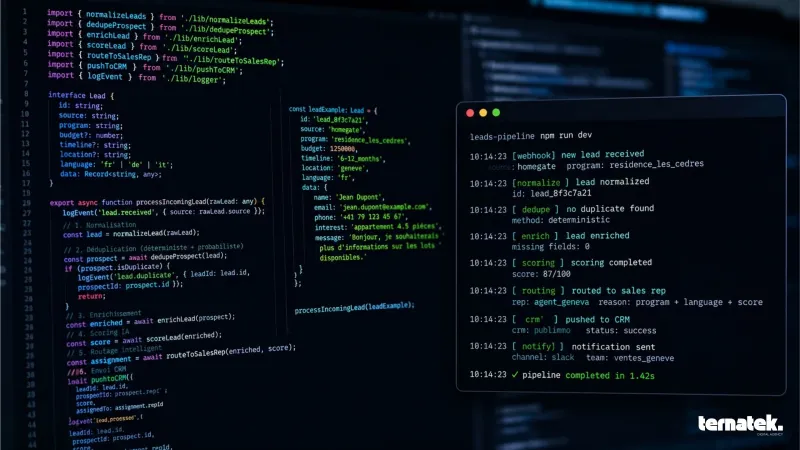
The most common mistake is treating AI as a layer added on top of an existing system: a chatbot wired to the site, with nothing changed behind it. An effective qualification architecture relies on a full chain: capturing leads from every source, normalizing them into a common format, deduplication, enrichment, AI scoring, routing based on business rules, then integration into the CRM with a notification to the right salesperson.
The chatbot is just one visible entry point in that chain — often the simplest part to build, and the least decisive for actual conversion.
A developer receives leads from very different sources: real estate portals, site forms, ad campaign landing pages, inbound calls, email. Each source has its own data format, its own fields, its own way of describing a request.
The technical work is connecting each source to a single entry point, via API or webhook depending on what the source allows, then normalizing every lead into a common data structure before it enters the system. Without that step, each source feeds the CRM its own way, and qualification becomes impossible to automate consistently.
The same prospect might fill out several forms, show interest in multiple units within one development, arrive through two different portals, or contact two separate salespeople without anyone noticing. Without deduplication, that prospect generates several competing records in the CRM, with the risk that two salespeople reach out in parallel — or worse, that neither does, each assuming the other has it covered.
Two levels of matching come into play here. Deterministic identification relies on reliable identifiers — email, phone number, portal ID — that let you conclude with certainty it’s the same prospect. Probabilistic matching relies on weaker signals — name, browsing behavior, request content, timing context — to estimate a likely match without absolute certainty. AI mainly operates at this second level, consolidating information into a single enriched prospect record rather than letting the system fragment a single opportunity — without ever replacing the reliability of the first.
The quality of a scoring model depends directly on the quality of the data feeding it: a poorly normalized, duplicated, or under-enriched lead will produce an unreliable score, however sophisticated the model. That’s why scoring comes after capture, normalization, deduplication, and enrichment in the chain, not in their place.
Two requests received the same day can carry radically different commercial value. The first: “I’d like to receive the brochure for this development.” The second: “We’ve sold our apartment and are looking for a 4-room unit to move into by 2027, budget CHF 1.8 million.” Both count as a lead in a system that just notifies when a form comes in. They shouldn’t get the same commercial priority.
Scoring means evaluating each lead against business criteria defined with the developer: budget, property type sought, purchase timeline, financing method, primary residence versus rental investment, targeted development, prior browsing behavior. A language model can analyze the free text of a request — what the prospect actually wrote, not just the boxes ticked on a form — to extract these criteria automatically, capturing information that most prospects never bother filling in fully on a standard form.
In a Swiss real estate context, this automation also needs to come with clear data governance: what information is sent to the model, where it’s processed, how long it’s retained, and which data can actually be used for scoring.
Once a lead is qualified and prioritized, the next question is who should receive it, and how. Basic routing just notifies the whole sales team. Intelligent routing accounts for a salesperson’s specialization on a given development, geographic area, each salesperson’s current workload, and how far along the lead is — a prospect ready to sign shouldn’t wait the same amount of time as a simple documentation request. In Switzerland, the language of the request — French, German, or Italian — is a routing criterion in its own right: a German-speaking lead misrouted to a French-speaking salesperson loses part of the benefit of a fast response.
That level of granularity is what separates an architecture built for a multi-development developer from a generic tool designed for an agency managing a handful of properties at a time.
The goal of this architecture isn’t to replace the salesperson with automation, but to minimize the delay between the moment a prospect shows interest and the moment the right person, armed with the right information, starts the conversation. Qualification, enrichment, and routing are automated; the sales relationship and the close stay human.
On a real estate project like Norwood, this logic takes on a concrete dimension: when a prospect shows interest in a development, the value isn’t only in capturing their contact details. It’s in the system’s ability to understand their intent and immediately hand a workable opportunity to the right person — rather than one more form landing in a shared inbox.
Concretely, a lead qualification stack for a real estate developer follows a structured chain: leads come in from portals, the site, and ad campaigns; they pass through APIs and webhooks; a normalization layer harmonizes formats; the data lands in a centralized prospect database; an AI qualification and scoring engine evaluates each lead; business rules apply the developer’s own routing logic; the result feeds the CRM with a notification to the right salesperson and reporting for follow-up.
It’s the same philosophy we detail for modern decoupled architectures in other contexts: independent building blocks connected through APIs, explicit business logic rather than a stack of ad hoc automations bolted onto a generic CRM.
| Criterion | Simple notification | Qualification architecture |
|---|---|---|
| Lead sources | Handled separately, often manually | Centralized and automatically normalized |
| Duplicates | Multiple records for the same prospect | Automatic deduplication and enrichment |
| Prioritization | None, first-come-first-served | Scored against defined business criteria |
| Routing | Blanket notification to the team | To the right salesperson, by rule |
| Time to first contact | Depends on team availability | Reduced through automated processing and routing |
| Suited for | A handful of properties, one salesperson | Multiple developments, multiple salespeople, high volume |
Response speed has become a decisive conversion factor in real estate again — that’s not new, it’s a reality documented for nearly two decades, but it’s intensified as developers compete directly for the same prospects on the same portals.
Answering that with a chatbot bolted on as a facade only solves a small part of the problem. The real answer is an architecture that captures, normalizes, deduplicates, enriches, prioritizes, and routes every lead to the right person — built for the real complexity of a multi-development developer, not bought as a generic tool designed for an agency managing a handful of properties at a time.
The competitive advantage, then, isn’t AI itself. It’s the ability to build an architecture around it capable of turning every request into a workable commercial opportunity, in minutes rather than hours.
An AI agent for a Swiss law firm can't be plugged in like any other tool: article 321 of the Swiss Criminal Code makes professional secrecy a criminal matter. A tour of the architectures that stay compliant.
Read the articleLovable generates React and, since 2026, TanStack Start with SSR — the same technical family as custom development in Astro or Next.js. Why the result still isn't comparable.
Read the articleTechnical answers for Swiss real estate developers considering automated lead qualification.