

Lovable vs Custom Development: Why the Same Stack Doesn't Produce the Same Website
By Gaël, Co-Founder / CTO
By Gaël, Co-Founder / CTO
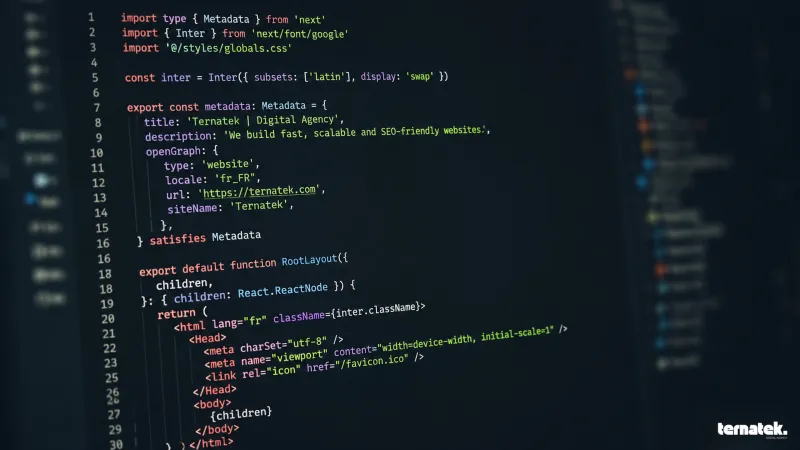
For the past year, one question keeps coming up in conversations with founders and product teams: “why not just build this on Lovable?” It’s a fair question. Lovable, v0, and other “vibe coding” tools turn a prompt into a working application in minutes.
What surprises our more technical contacts is discovering that Lovable runs on the same technology family as custom development: React, TypeScript, Tailwind CSS, and since 2026, a server-rendering framework comparable in spirit to Next.js. So why isn’t the result comparable?
This article breaks down what’s actually running behind a Lovable-generated site, why the tool had to evolve its technical architecture in 2026, and what still separates a generated prototype from a website built to last.
Lovable belongs to a generation of tools — alongside Vercel’s v0 or Bolt — that turn a prompt into a full web application: interface, business logic, database. The typical use case: a founder describes their idea in plain language, gets a testable application in a few hours, and validates a concept without writing a line of code.
That use case is real and legitimate. The problem shows up when that prototype, built to validate quickly, quietly becomes the public website meant to carry a company’s acquisition, credibility, and organic visibility over the long run.
Technically, Lovable generates React applications with TypeScript, Tailwind CSS for styling, and shadcn/ui components built on Radix UI for the interface. The default backend relies on Supabase (PostgreSQL, auth, storage, serverless functions) through Lovable Cloud.
Until May 2026, these applications were SPAs (Single Page Applications) built with Vite: all rendering happened in the browser, after the JavaScript bundle downloaded and executed. Since then, new Lovable projects use TanStack Start, a framework that adds server-side rendering (SSR). For existing projects still on the SPA model, Lovable added automatic pre-rendering: static HTML snapshots generated for crawlers, with no manual migration required. It’s an effective fix, but it isn’t the same as rendering handled natively by the framework, route by route.
That’s exactly the technical family you find in modern custom development: React or an equivalent, a framework with server rendering, a coherent design system. On paper, “the same thing.”
This architecture shift isn’t trivial. A SPA without server rendering has a structural problem: on first load, the HTML sent to the browser (and to Googlebot) is nearly empty. Content only appears after the JavaScript bundle downloads and executes, which directly hurts LCP and complicates indexing.
We’ve made this point for a long time in our approach to performance-first, SEO-first website development: server-side rendering isn’t an implementation detail, it’s a structural condition for a site to be both fast and properly indexable.
That the AI no-code industry itself migrated to an SSR framework in 2026 confirms this principle rather than contradicting it. Even tools built to move as fast as possible had to absorb this constraint to stay credible for sites meant for real-world use.
Sharing the same technology family doesn’t guarantee the same quality of execution. Several structural differences remain between a generated project and a custom-built one. None of these are automatic verdicts: a poorly architected custom project can accumulate as much debt as a generated prototype, and a Lovable project picked up and restructured by a developer can become perfectly maintainable. What follows describes structural tendencies tied to the generation process, not an absolute rule.
Rendering granularity per page. Custom development in Astro or Next.js generally chooses the rendering strategy page by page: static for a stable product page, server-rendered for content that changes, incremental regeneration for a blog. A prompt-generated project tends to apply a more uniform strategy across the whole site — not because of a technical limit in the underlying framework, but because a process built on successive instructions rarely invites that level of granularity from the start.
Weight and relevance of the JavaScript. Prompt-generated code tends to be more generic: unused components kept around, dependencies added “just in case,” little manual tree-shaking. Custom development strips out what doesn’t serve this specific project more systematically — a gap in discipline, not a technical inevitability.
Systematic technical SEO control. As of 2026, Lovable generates basic meta tags, an automatic robots.txt, and lets you create sitemaps, structured data, or internal linking via prompts. That’s no longer the real gap. The real gap is that this configuration stays declarative and one-off — requested page by page in the chat — rather than built into the architecture from the start, the way canonical tags, hreflang, or schema.org markup get generated systematically for every route through the routing system itself in an Astro or Next.js project. In other words: Lovable makes SEO possible; custom development makes it systematic and industrialized.
Governance and coherence of generated code. The real issue isn’t “AI-generated code is bad” — as noted below, the generated interface foundation is actually fairly clean. The issue is the process: prompt, generation, rapid iteration, an accumulation of local decisions, often without an overall architecture review. A project can gradually drift into inconsistent conventions and abstractions this way. None of it is irreversible: a developer picking up that code can restructure it and reintroduce coherence, conventions, and separation of concerns. But that’s a genuine take-over effort, not a property the code has from the moment it’s generated.
Portability and vendor lock-in. The default backend (Supabase via Lovable Cloud) and its associated hosting create a structural dependency on the platform. Migrating later means a partial rewrite, not a simple export.
To their credit, shadcn/ui and Radix UI produce a fairly clean and accessible interface foundation — that’s not where the main gap sits. The gap is in the architecture, the fine-grained control over rendering, and the code’s governance over time, not the intrinsic quality of the generated code at a given moment.
Once you commit to custom development, two frameworks naturally come up.
Astro produces static HTML by default and only ships JavaScript to the browser when interactive components genuinely need it (islands architecture). It’s the strongest choice for a content-heavy site: marketing site, blog, editorial site, strategic SEO.
Next.js offers more flexibility for applications with significant state and interactivity: server rendering, static generation, incremental static regeneration (ISR), all within one framework. It’s the right call for a SaaS product, a dashboard, or e-commerce with complex dynamic logic.
This choice echoes what we detail in our article on WordPress alternatives for a high-performance website: the question is never “which tool is best in the abstract,” but “which architecture fits this product.”
It would be dishonest to present Lovable as a bad choice across the board. The tool excels at validating an idea before investing in full development, building an internal tool with no SEO exposure, preparing a demo for an investor, or testing a user flow before locking it in.
In these contexts, execution speed matters far more than fine-grained architectural control. The prototype doesn’t need to be indexed by Google or handle significant load.
The problem isn’t Lovable itself, but the moment a prototype quietly becomes the production site without anyone revisiting what comes next. A company that publicly launches a commercial offering on a generated base without ever revisiting that question exposes itself to two concrete risks: organic acquisition that becomes harder to industrialize as the content strategy and the number of routes grow, and architectural debt that becomes expensive to fix once traffic or features pile up — especially if no one has picked up the code to restructure its governance.
The most effective path we see with our clients follows a fairly natural progression: fast prototype, concept validation, early traction signals, then a real need for SEO acquisition and growth — which surfaces the need for architectural control. We don’t ask a company to throw away its Lovable prototype: we turn what’s already been validated — design, flows, product logic — into a custom architecture built to last. This is usually faster and cheaper than a from-scratch project, since the product decisions are already made thanks to the prototype.
| Criterion | Lovable (generated) | Custom development (Astro / Next.js) |
|---|---|---|
| Prototyping speed | Very fast, hours | Slower, weeks |
| Architectural control | Limited, depends on prompts | Complete, decided at design time |
| SEO industrialization | Decent basics, manual configuration | Systematic, built into routing |
| Per-route rendering optimization | Rare, global strategy by default | Standard, chosen page by page |
| Scalability | Variable, depends on the code hand-off | Planned from the start |
| Maintenance | Heavily depends on the project and who picks it up | Defined by the architecture, more predictable |
| Ideal use case | Prototype, MVP, idea validation | Product meant to last and scale |
Lovable and custom development in Astro or Next.js draw on closely related technology families, and that convergence will likely keep increasing. But using React or an SSR framework isn’t, on its own, enough to produce an architecture built for performance, SEO, and long-term maintainability — that mostly depends on the process that produced the code, and who keeps governing it over time.
The real choice isn’t “AI versus code,” it’s “prototype optimized to learn fast versus architecture optimized to last.” A Lovable prototype has real value: it buys product knowledge at a speed and cost nothing else matches. Custom development takes over once that knowledge needs to become an asset that carries an SEO strategy, absorbs real load, and evolves over several years.
A Swiss real estate lead is no longer won or lost over days, but minutes. Why the answer isn't bolting on a chatbot, but building the architecture that turns a lead into a workable opportunity.
Read the articleAn AI agent for a Swiss law firm can't be plugged in like any other tool: article 321 of the Swiss Criminal Code makes professional secrecy a criminal matter. A tour of the architectures that stay compliant.
Read the articleTechnical answers to help you choose between an AI-generated website and a custom architecture.